Money and Banking (Macroeconomics) — Important Questions
59 questions
With answersCBSE format
SUMMARY: This chapter explores the role and functions of money in an economy, the banking system, and how monetary policy is implemented in India. KEY TOPICS: Functions of money, types of money, commercial banks, central bank functions, monetary policy, money supply, credit creation, Reserve Bank of India, instruments of monetary policy, liquidity adjustment facility.
Which of the following is NOT a function of a commercial bank?
AAccepting deposits
BGranting loans and advances
CIssuing currency notes
DCredit creation
Check answerHide answer
Correct answer: Option 3 — Issuing currency notes
Q21 Mark
Cash Reserve Ratio (CRR) is maintained by commercial banks with:
AState Bank of India
BReserve Bank of India
CMinistry of Finance
DEach bank in its own vault
Check answerHide answer
Correct answer: Option 2 — Reserve Bank of India
Q31 Mark
Statutory Liquidity Ratio (SLR) requires commercial banks to hold:
ALiquid assets like cash gold or government securities
BOnly cash with the RBI
COnly foreign currency
DOnly equity shares
Check answerHide answer
Correct answer: Option 1 — Liquid assets like cash gold or government securities
Q41 Mark
An increase in repo rate by RBI tends to:
AIncrease commercial bank borrowing from RBI
BDecrease commercial bank borrowing from RBI
CHave no impact
DDecrease CRR
Check answerHide answer
Correct answer: Option 2 — Decrease commercial bank borrowing from RBI
Q51 Mark
Money multiplier in a banking system equals:
ACRR / 1
B1 / Cash Reserve Ratio
CCRR × Initial deposit
D1 / Repo rate
Check answerHide answer
Correct answer: Option 2 — 1 / Cash Reserve Ratio
Q61 Mark
Which of the following is considered the PRIMARY function of money?
AStore of value
BMedium of exchange
CStandard of deferred payment
DMeasure of value
Check answerHide answer
Correct answer: Option 2 — Medium of exchange
Q71 Mark
The Cash Reserve Ratio (CRR) is the minimum fraction of deposits that commercial banks are required to keep with:
AThe Government of India
BTheir own vaults as cash
CThe Reserve Bank of India
DThe State Bank of India
Check answerHide answer
Correct answer: Option 3 — The Reserve Bank of India
Q81 Mark
If the Legal Reserve Ratio (LRR) is 20%, what will be the value of the money multiplier?
A2
B4
C5
D20
Check answerHide answer
Correct answer: Option 3 — 5
Q91 Mark
Which of the following is NOT a function of the Reserve Bank of India?
AActing as banker to the government
BIssuing currency notes
CAccepting deposits from the general public
DActing as lender of last resort
Check answerHide answer
Correct answer: Option 3 — Accepting deposits from the general public
Q101 Mark
When the RBI purchases government securities from commercial banks in the open market, this operation leads to:
ADecrease in money supply in the economy
BIncrease in money supply in the economy
CNo change in money supply
DDecrease in the bank rate
Check answerHide answer
Correct answer: Option 2 — Increase in money supply in the economy
Q111 Mark
The Statutory Liquidity Ratio (SLR) requires commercial banks to maintain a certain proportion of their Net Demand and Time Liabilities (NDTL) in the form of:
AOnly cash reserves with RBI
BForeign exchange reserves
CGold, cash, or approved government securities
DFixed deposits with other commercial banks
Check answerHide answer
Correct answer: Option 3 — Gold, cash, or approved government securities
Q121 Mark
Under the Liquidity Adjustment Facility (LAF), the rate at which commercial banks borrow funds overnight from the RBI is called:
AReverse Repo Rate
BBank Rate
CRepo Rate
DMarginal Standing Facility Rate
Check answerHide answer
Correct answer: Option 3 — Repo Rate
Q131 Mark
M1 measure of money supply in India includes:
ACurrency with public + demand deposits + time deposits with banks
BCurrency with public + demand deposits with banks + other deposits with RBI
CCurrency with public + time deposits + post office savings deposits
DCurrency with public only
Check answerHide answer
Correct answer: Option 2 — Currency with public + demand deposits with banks + other deposits with RBI
Q141 Mark
A commercial bank has total deposits of ₹10,000 crore. The LRR is 10%. If an initial fresh deposit of ₹1,000 crore is made, what will be the TOTAL deposit creation in the economy (including the initial deposit)?
A₹9,000 crore
B₹10,000 crore
C₹11,000 crore
D₹1,000 crore
Check answerHide answer
Correct answer: Option 2 — ₹10,000 crore
Q151 Mark
During a period of inflationary pressure in the economy, which combination of monetary policy measures would the RBI MOST likely adopt?
ADecrease repo rate, decrease CRR, buy government securities
BIncrease repo rate, increase CRR, sell government securities
CIncrease repo rate, decrease SLR, buy government securities
DDecrease bank rate, increase CRR, sell government securities
Explain briefly how commercial banks create credit.
View sample solutionHide solution
Banks keep only a fraction of deposits as reserves (the LRR) and lend out the rest. The borrowed money returns to the banking system as fresh deposits, which are again partly loaned out. This cycle produces a multiple expansion of deposits equal to 1/LRR times the initial primary deposit.
Q173 Marks
State any two qualitative tools of monetary policy used by the RBI.
View sample solutionHide solution
(i) Margin requirements — RBI stipulates the minimum margin between the loan amount and the value of the security, discouraging speculative lending. (ii) Moral suasion — RBI persuades/requests commercial banks, through letters and meetings, to follow a desired credit policy.
Q183 Marks
Define money supply. Distinguish between M1 and M3.
View sample solutionHide solution
Money supply is the total stock of money held by the public in spendable form at a given point in time. M1 (narrow money) = currency with the public + demand deposits with commercial banks + other deposits with RBI. M3 (broad money) = M1 + time deposits with commercial banks. M3 is the most widely used measure of money supply in India because it captures both transaction money and savings money held in the banking system.
Q193 Marks
What is meant by 'high-powered money'? Why is it called so?
View sample solutionHide solution
High-powered money (also called monetary base or reserve money) refers to the currency issued by the monetary authority (RBI) plus the deposits of commercial banks with the RBI. It is called high-powered because each unit of high-powered money supports a multiple of money supply through the credit-creation process of commercial banks. The money multiplier links high-powered money to total money supply: Money Supply = Money Multiplier × High-Powered Money.
Q203 Marks
Explain the role of RBI as the lender of last resort.
View sample solutionHide solution
As lender of last resort the RBI provides emergency credit to commercial banks that face temporary liquidity crises. When other sources of borrowing fail commercial banks can approach the RBI for short-term loans against eligible securities. This function is critical because it prevents temporary liquidity problems from becoming bank failures which could trigger panic withdrawals (bank runs) and damage confidence in the entire banking system. By backstopping the banks the RBI maintains stability and continuity of the financial system.
Q213 Marks
What is meant by 'money supply' in an economy?
View sample solutionHide solution
Money supply refers to the total stock of money in circulation in an economy at a given point of time. It includes currency (notes and coins) held by the public and demand deposits held in commercial banks. In India, the Reserve Bank of India measures money supply through different aggregates such as M1, M2, M3, and M4.
Q223 Marks
State any two primary functions of money.
View sample solutionHide solution
The two primary functions of money are: (i) Medium of Exchange — money acts as an intermediary in the exchange of goods and services, eliminating the need for a double coincidence of wants. (ii) Measure of Value — money serves as a common unit of measurement that expresses the value of all goods and services in terms of price.
Q233 Marks
What is the Cash Reserve Ratio (CRR)?
View sample solutionHide solution
Cash Reserve Ratio (CRR) is the minimum percentage of a commercial bank's total deposits that it is required to keep as cash reserves with the Reserve Bank of India. It is a quantitative instrument of monetary policy used by the RBI to control the money supply and credit creation in the economy. An increase in CRR reduces the lending capacity of banks.
Q243 Marks
Explain the concept of 'credit creation' by commercial banks.
View sample solutionHide solution
Credit creation refers to the ability of commercial banks to multiply the initial deposits into a much larger amount of credit (loans) in the economy. When a bank receives a deposit, it keeps a fraction as reserve (CRR) and lends out the rest, which again gets deposited in banks and the process repeats. This multiplier effect leads to the creation of credit many times the original deposit.
Q253 Marks
Differentiate between 'narrow money' (M1) and 'broad money' (M3).
View sample solutionHide solution
M1 (narrow money) includes currency notes and coins held by the public plus demand deposits of commercial banks, representing the most liquid form of money. M3 (broad money) includes M1 plus time deposits (fixed deposits) held with commercial banks, making it a broader and less liquid measure of money supply. M3 is the most commonly used measure of money supply in India.
Long Answer Questions6 questions
Q266 Marks
Explain the process of credit creation by commercial banks with a numerical example, clearly stating the assumptions.
View sample solutionHide solution
Assumptions: single banking system, all transactions through banks, uniform LRR, no cash leakage. Suppose LRR = 20% (0.2) and initial primary deposit = ₹1,000. Money multiplier = 1/LRR = 5. Round 1: Bank keeps ₹200 as reserves, lends ₹800; borrower spends it, recipient deposits ₹800. Round 2: Bank keeps ₹160, lends ₹640, and so on. Total deposits created in the system = 1,000 × 5 = ₹5,000. Thus an initial deposit of ₹1,000 produces ₹5,000 of demand deposits, demonstrating the multiple credit-creation power of the banking system.
Q276 Marks
Discuss the quantitative and qualitative instruments used by the RBI to control credit.
View sample solutionHide solution
Quantitative (volume of credit): (a) Bank Rate — RBI's lending rate to commercial banks; raising it discourages borrowing. (b) Open Market Operations — sale/purchase of government securities by RBI to absorb or inject liquidity. (c) CRR — minimum fraction of deposits banks must keep with RBI. (d) SLR — minimum liquid assets to be held by banks. (e) Repo and Reverse-Repo rates. Qualitative (direction of credit): (i) Margin requirements against specific securities, (ii) Moral suasion, (iii) Selective credit controls, and (iv) Direct action against defaulting banks. Together they influence the cost and availability of credit.
Q286 Marks
Explain the functions of money. Show how money has overcome the limitations of barter.
View sample solutionHide solution
FUNCTIONS OF MONEY: (1) Medium of exchange — money is universally accepted in payment for goods services and debts. (2) Measure of value (unit of account) — money provides a common unit in which the value of all goods and services is expressed. (3) Store of value — money can be saved and used in the future as it preserves purchasing power. (4) Standard of deferred payment — borrowing and lending are calculated and repaid in money terms. (5) Transfer of value — money allows the transfer of wealth from one person or place to another. LIMITATIONS OF BARTER OVERCOME: (a) Lack of double coincidence of wants — money allows any seller to find a buyer. (b) Lack of common measure of value — money provides a single unit. (c) Difficulty in storing wealth — money is more durable and divisible than perishable goods. (d) Difficulty in deferred payments — money allows borrowing and lending. (e) Difficulty in transferring value — money is portable. Money therefore makes economic activity efficient and large-scale exchange possible.
Q296 Marks
Explain the central banking functions of the Reserve Bank of India.
View sample solutionHide solution
As the central bank of the country the RBI performs several key functions. (1) Bank of issue — RBI has the sole right to issue currency notes (except one-rupee notes). (2) Banker to the government — RBI manages government accounts handles public debt and provides loans to central and state governments. (3) Banker's bank and supervisor — all commercial banks maintain accounts with RBI; RBI regulates and supervises their working. (4) Lender of last resort — RBI provides emergency liquidity to banks in crisis. (5) Custodian of foreign exchange reserves — RBI manages India's foreign-currency reserves and the exchange rate. (6) Controller of credit — RBI uses quantitative tools (CRR SLR repo rate bank rate open-market operations) and qualitative tools (margin requirements moral suasion selective controls) to regulate the money supply. (7) Clearing house function — RBI manages the inter-bank clearing system. Through these functions the RBI ensures monetary stability and a healthy financial system.
Q306 Marks
Explain the deposit creation process by commercial banks with a numerical example. State the assumptions clearly.
View sample solutionHide solution
Assumptions: (a) single banking system with all transactions through banks; (b) uniform LRR; (c) no cash leakage out of the system; (d) banks lend out the entire excess reserves. Suppose the LRR is 10% (0.10) and the initial primary deposit in the banking system is ₹10000. Money multiplier = 1/LRR = 1/0.10 = 10. Round 1: Bank A receives ₹10000 keeps ₹1000 as reserves and lends out ₹9000. The borrower spends it; the recipient deposits it in Bank B. Round 2: Bank B keeps 10% of ₹9000 = ₹900 as reserves and lends ₹8100. Round 3: Bank C keeps ₹810 and lends ₹7290. The process continues. Total deposits created in the system = 10000 × 10 = ₹100000. Thus an initial deposit of ₹10000 produces ₹100000 of total demand deposits. The banking system has multiplied the original deposit ten-fold demonstrating the credit-creation power of commercial banks.
Q316 Marks
Differentiate between barter system and monetary system in tabular form on five features.
Assertion–Reason Questions8 questions
Q321 Mark
Assertion (A): An increase in CRR reduces the money supply in the economy.
Reason (R): A higher CRR leaves commercial banks with smaller lendable funds, reducing credit creation.
Show explanationHide explanation
Correct answer: Option 1 —
Both A and R are true, and R is the correct explanation of A.
Q331 Mark
Assertion (A): The Reserve Bank of India acts as banker to the Government.
Reason (R): The RBI accepts deposits only from commercial banks and not from the central government.
Show explanationHide explanation
Correct answer: Option 3 —
A is true, but R is false.
Q341 Mark
Assertion (A): The money multiplier varies inversely with the cash reserve ratio.
Reason (R): A higher CRR leaves banks with smaller excess reserves to lend out reducing credit creation.
Show explanationHide explanation
Correct answer: Option 1 —
Both A and R are true, and R is the correct explanation of A.
Q351 Mark
Assertion (A): The sale of government securities by RBI through open market operations reduces money supply.
Reason (R): Such sales withdraw liquidity from commercial banks who pay for the securities by drawing down their reserves.
Show explanationHide explanation
Correct answer: Option 1 —
Both A and R are true, and R is the correct explanation of A.
Q361 Mark
Assertion (A): An increase in the repo rate generally raises the lending rates of commercial banks.
Reason (R): Higher cost of borrowing from the RBI is passed on by banks to their own borrowers as higher loan rates.
Show explanationHide explanation
Correct answer: Option 1 —
Both A and R are true, and R is the correct explanation of A.
Q371 Mark
Assertion (A): Money acts as a medium of exchange in an economy.
Reason (R): Money eliminates the need for double coincidence of wants which was a major drawback of the barter system.
Show explanationHide explanation
Correct answer: Option 1 —
Both A and R are true, and R is the correct explanation of A.
Q381 Mark
Assertion (A): Commercial banks are required to maintain a minimum Cash Reserve Ratio (CRR) with the Reserve Bank of India.
Reason (R): CRR is a quantitative instrument of monetary policy used by the RBI to control money supply in the economy.
Show explanationHide explanation
Correct answer: Option 1 —
Both A and R are true, and R is the correct explanation of A.
Q391 Mark
Assertion (A): An increase in the Statutory Liquidity Ratio (SLR) leads to an increase in credit creation by commercial banks.
Reason (R): A higher SLR means banks must maintain more liquid assets, leaving less funds available for lending.
Show explanationHide explanation
Correct answer: Option 4 —
A is false, but R is true.
Statement-Based Questions8 questions
Q401 Mark
Statement 1: Demand deposits have a high degree of liquidity.
Statement 2: Time deposits form part of the monetary aggregate M1.
Show answerHide answer
Correct answer: Option 3 —
Only Statement 2 is true.
Q411 Mark
Statement 1: An increase in the Bank Rate discourages commercial banks from borrowing from the RBI.
Statement 2: Open market operations involve the sale and purchase of government securities by the RBI.
Show answerHide answer
Correct answer: Option 1 —
Both statements are true.
Q421 Mark
Statement 1: Commercial banks accept deposits and grant loans.
Statement 2: The difference between the lending rate and the deposit rate is one of the main sources of bank profit.
Show answerHide answer
Correct answer: Option 1 —
Both statements are true.
Q431 Mark
Statement 1: The repo rate is the rate at which RBI lends to commercial banks against government securities.
Statement 2: The reverse repo rate is the rate at which RBI borrows from commercial banks.
Show answerHide answer
Correct answer: Option 1 —
Both statements are true.
Q441 Mark
Statement 1: M1 is the most liquid measure of money supply.
Statement 2: M3 includes time deposits and is therefore broader than M1.
Show answerHide answer
Correct answer: Option 1 —
Both statements are true.
Q451 Mark
Statement 1: Money acts as a medium of exchange, eliminating the need for double coincidence of wants.
Statement 2: Barter system is more efficient than a monetary economy because it involves direct exchange of goods.
Show answerHide answer
Correct answer: Option 2 —
Only Statement 1 is true.
Q461 Mark
Statement 1: Commercial banks create credit by lending out a fraction of their deposits, keeping only a required reserve ratio.
Statement 2: The credit multiplier is calculated as the reciprocal of the Cash Reserve Ratio (CRR).
Show answerHide answer
Correct answer: Option 1 —
Both statements are true.
Q471 Mark
Statement 1: The Reserve Bank of India acts as the lender of last resort to commercial banks during financial crises.
Statement 2: The RBI directly lends money to the general public to meet their credit requirements.
Show answerHide answer
Correct answer: Option 2 —
Only Statement 1 is true.
Case Study / Passage Questions4 questions
Q483 Marks
A commercial bank receives an initial primary deposit of ₹1000 from a customer. The Legal Reserve Ratio (LRR) is 20% and there is no cash leakage. All borrowers redeposit the loaned money back into the banking system.
The value of the money multiplier (k) is:
A2
B3
C4
D5
Total deposits eventually created by the banking system are:
A₹3000
B₹4000
C₹5000
D₹6000
State the two key assumptions of this credit-creation result.
Show answersHide answers
1. Option 4 — 5
2. Option 3 — ₹5000
3. (i) A single banking system in which all transactions are routed through banks. (ii) A uniform LRR of 20% with no cash leakage — every rupee lent is redeposited.
Q493 Marks
In May 2022, facing rising inflation, the RBI raised the repo rate by 40 basis points. Over the next year, further hikes followed. Commercial banks passed on the increase to their borrowers by revising their MCLR.
Repo rate refers to:
ARate at which RBI borrows from banks
BRate at which banks borrow from RBI
CRate on long-term government bonds
DInter-bank lending rate
An increase in the repo rate is primarily aimed to:
AIncrease money supply
BReduce money supply and control inflation
CEncourage lending
DRaise forex reserves
Explain how a higher repo rate affects commercial banks' lending behaviour.
Show answersHide answers
1. Option 2 — Rate at which banks borrow from RBI
2. Option 2 — Reduce money supply and control inflation
3. When the repo rate rises, banks' own cost of borrowing from the RBI increases, which they pass on by raising lending rates (MCLR). Higher lending rates discourage borrowing by firms and households, cooling aggregate demand and inflation.
Q503 Marks
During a period of high inflation the RBI simultaneously (i) raises CRR, (ii) sells government securities in the open market, and (iii) requests banks, through a letter, to restrict real-estate lending.
An increase in CRR is an example of:
AA quantitative tool
BA qualitative tool
CA fiscal tool
DNone of these
Open-market sale of government securities ______ liquidity with the banking system.
AIncreases
BDecreases
CKeeps unchanged
DDoubles
How does moral suasion differ from CRR as a monetary policy tool?
Show answersHide answers
1. Option 1 — A quantitative tool
2. Option 2 — Decreases
3. Moral suasion is a qualitative tool — the RBI uses persuasion and advice to influence the direction of credit without any legal force. CRR is a quantitative tool — a legally binding reserve requirement that directly controls the volume of credit.
Q514 Marks
Money is anything that is generally accepted as a medium of exchange. Before money, people used the barter system where goods were exchanged for goods. The barter system had several limitations such as the double coincidence of wants, lack of a common measure of value, and difficulty in storing wealth. Money overcame these limitations by serving as a medium of exchange, a unit of account, a store of value, and a standard of deferred payment. Modern economies use different forms of money including commodity money, fiat money, and bank money. In India, the Reserve Bank of India is authorized to issue currency notes, while the Government of India issues coins. The value of money is not intrinsic but is backed by government authority.
Which of the following is NOT a function of money?
AMedium of exchange
BStore of value
CProduction of goods
DUnit of account
What is the main limitation of the barter system that money overcomes?
ALack of technology
BDouble coincidence of wants
CShortage of goods
DAbsence of banks
Explain the function of money as a 'store of value'.
In India, who is authorized to issue currency notes?
AGovernment of India
BState Bank of India
CReserve Bank of India
DMinistry of Finance
Show answersHide answers
1. Option 3 — Production of goods
2. Option 2 — Double coincidence of wants
3. Money as a store of value means that money can be saved and used in the future. It allows individuals to store purchasing power over time, unlike perishable goods in a barter system. This enables people to accumulate wealth and use it whenever needed.
4. Option 3 — Reserve Bank of India
Table-Based Questions4 questions
Q523 Marks
Study the monetary aggregates and answer the questions:
Item
Amount (₹ cr)
Currency with the public
200
Demand deposits with banks
300
Other deposits with RBI
10
Time deposits with banks
400
M1 (narrow money) in this economy equals:
A₹500 cr
B₹510 cr
C₹700 cr
D₹910 cr
M3 (broad money) equals:
A₹500 cr
B₹510 cr
C₹900 cr
D₹910 cr
What is the key difference between M1 and M3?
Show answersHide answers
1. Option 2 — ₹510 cr
2. Option 4 — ₹910 cr
3. M1 is the most liquid aggregate — cash plus demand deposits plus other deposits with RBI. M3 is broader and includes net time deposits. The difference (₹400 cr here) represents the less liquid deposits.
Q533 Marks
Study the bank reserve requirements and answer:
Item
Value
Total deposits (₹ cr)
500
CRR
4%
SLR
18%
Cash in hand (₹ cr)
25
Cash reserves held with the RBI (CRR holdings) amount to:
A₹10 cr
B₹15 cr
C₹20 cr
D₹25 cr
SLR holdings amount to:
A₹80 cr
B₹85 cr
C₹90 cr
D₹100 cr
What is meant by SLR and why is it prescribed?
Show answersHide answers
1. Option 3 — ₹20 cr
2. Option 3 — ₹90 cr
3. SLR (Statutory Liquidity Ratio) is the minimum proportion of a bank's Net Demand and Time Liabilities that must be maintained in safe liquid assets like cash, gold, or approved government securities. It limits credit creation and ensures solvency.
Q544 Marks
Compute the money multiplier and total deposits created in the banking system from the data below, assuming no cash leakage.
Variable
Value
Primary deposit (₹)
1000
Legal Reserve Ratio (LRR)
20% (0.20)
Cash leakage
None
Q555 Marks
Calculate the M1 and M3 monetary aggregates from the data below.
Item
Value (₹ cr)
Currency with the public
200
Demand deposits with banks
300
Other deposits with RBI
10
Time deposits with banks
400
Picture-Based Questions4 questions
Q563 Marks
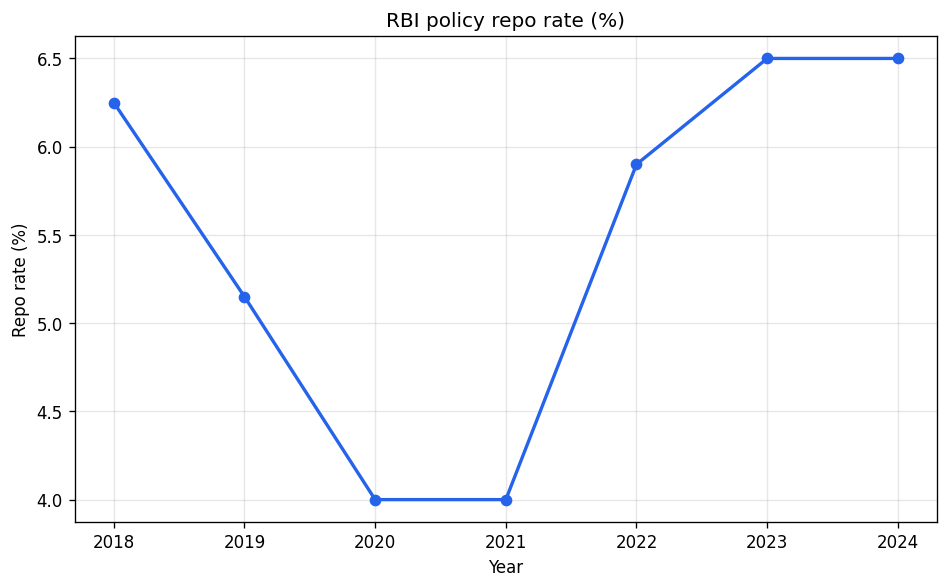
Study the repo-rate trend and answer:
Between 2019 and 2020 the repo rate:
AFell sharply
BRose sharply
CRemained constant
DDoubled
The rise in repo rate from 2022 onwards was mainly intended to:
AEncourage lending
BFight inflation by tightening credit
CReduce forex reserves
DRaise fiscal deficit
Explain the transmission channel through which a change in the repo rate affects the broader economy.
Show answersHide answers
1. Option 1 — Fell sharply
2. Option 2 — Fight inflation by tightening credit
3. A cut lowers the cost at which banks borrow from the RBI, which feeds into lower lending rates and supports demand. A hike does the reverse — discouraging borrowing and cooling aggregate demand, typically used to control inflation.
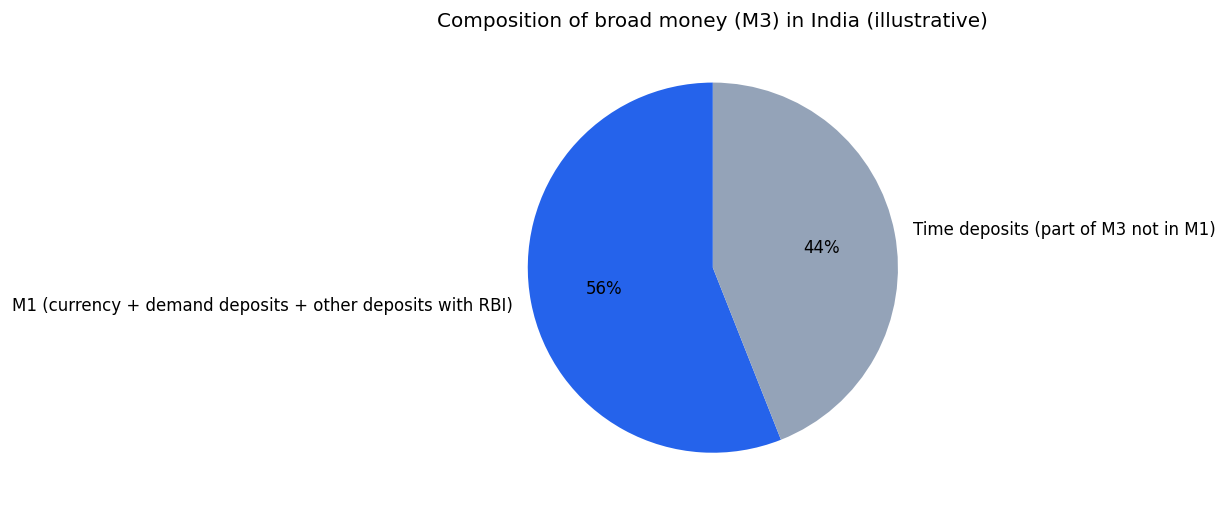
Q573 Marks
Study the composition of money supply and answer:
Which of the following is NOT a component of M1?
ACurrency with the public
BDemand deposits with banks
COther deposits with the RBI
DTime deposits with banks
M3 minus M1 primarily consists of:
ACurrency
BDemand deposits
CTime deposits
DGold reserves
Why are time deposits considered less liquid than demand deposits?
Show answersHide answers
1. Option 4 — Time deposits with banks
2. Option 3 — Time deposits
3. Time deposits are held for a fixed period and cannot be withdrawn on demand without penalty; demand deposits, in contrast, are payable on demand via cheque or debit card. Time deposits are therefore less liquid but usually pay higher interest.
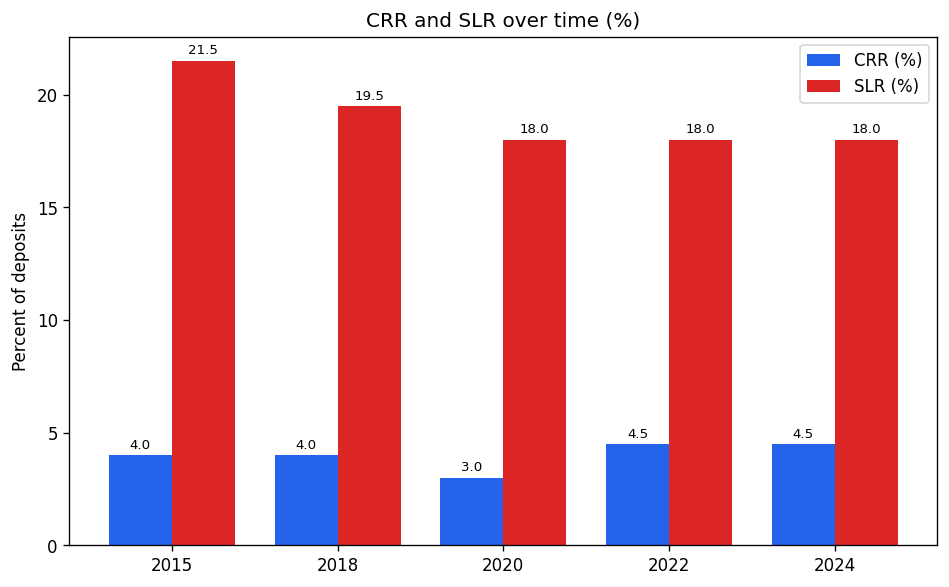
Q583 Marks
Study the trend of CRR and SLR and answer:
The drop in CRR to 3% in 2020 reflected:
ATightening to fight inflation
BEasing to inject liquidity during COVID-19
CExchange-rate management
DNo change in stance
SLR (Statutory Liquidity Ratio) is:
AAn optional reserve for banks
BMinimum liquid assets banks must hold in cash, gold or approved securities
CAn interest rate
DForeign exchange reserve with the RBI
Why did the RBI cut CRR during the COVID-19 period?
Show answersHide answers
1. Option 2 — Easing to inject liquidity during COVID-19
2. Option 2 — Minimum liquid assets banks must hold in cash, gold or approved securities
3. Cutting CRR releases a larger share of bank deposits as lendable funds, making it easier for banks to extend credit to businesses and households. During COVID-19 the RBI used this tool to support the economy when demand collapsed.
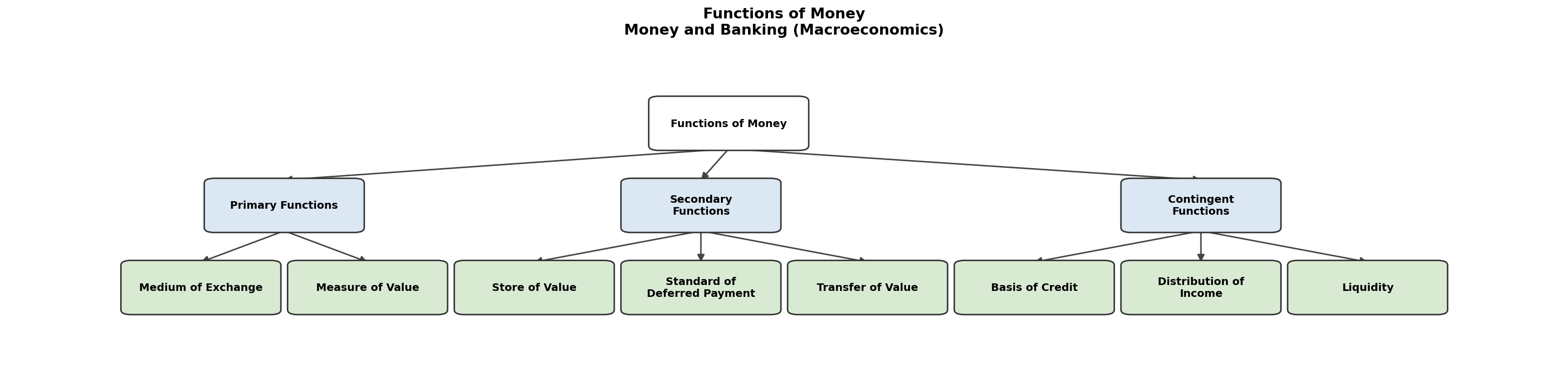
Q594 Marks
Based on the given flowchart showing the functions of money, answer the following:
Which of the following is a PRIMARY function of money as shown in the diagram?
AStore of Value
BBasis of Credit
CMedium of Exchange
DTransfer of Value
How does money solve the problem of 'double coincidence of wants'? Refer to the relevant function shown in the diagram.
Which secondary function of money allows people to make payments in the future for goods and services received today?
AStore of Value
BStandard of Deferred Payment
CTransfer of Value
DLiquidity
Explain the 'Store of Value' function of money and state one limitation of this function.
Show answersHide answers
1. Option 3 — Medium of Exchange
2. Money solves the problem of double coincidence of wants through its function as a Medium of Exchange. In a barter system, both parties must want what the other offers simultaneously. Money eliminates this by acting as a common medium — a seller accepts money and uses it to buy whatever they need from anyone.
3. Option 2 — Standard of Deferred Payment
4. Store of Value means money can be saved and used in the future, preserving purchasing power over time. Limitation: During periods of high inflation, the real value of money falls, making it a poor store of value as the same amount of money buys fewer goods and services.